Media
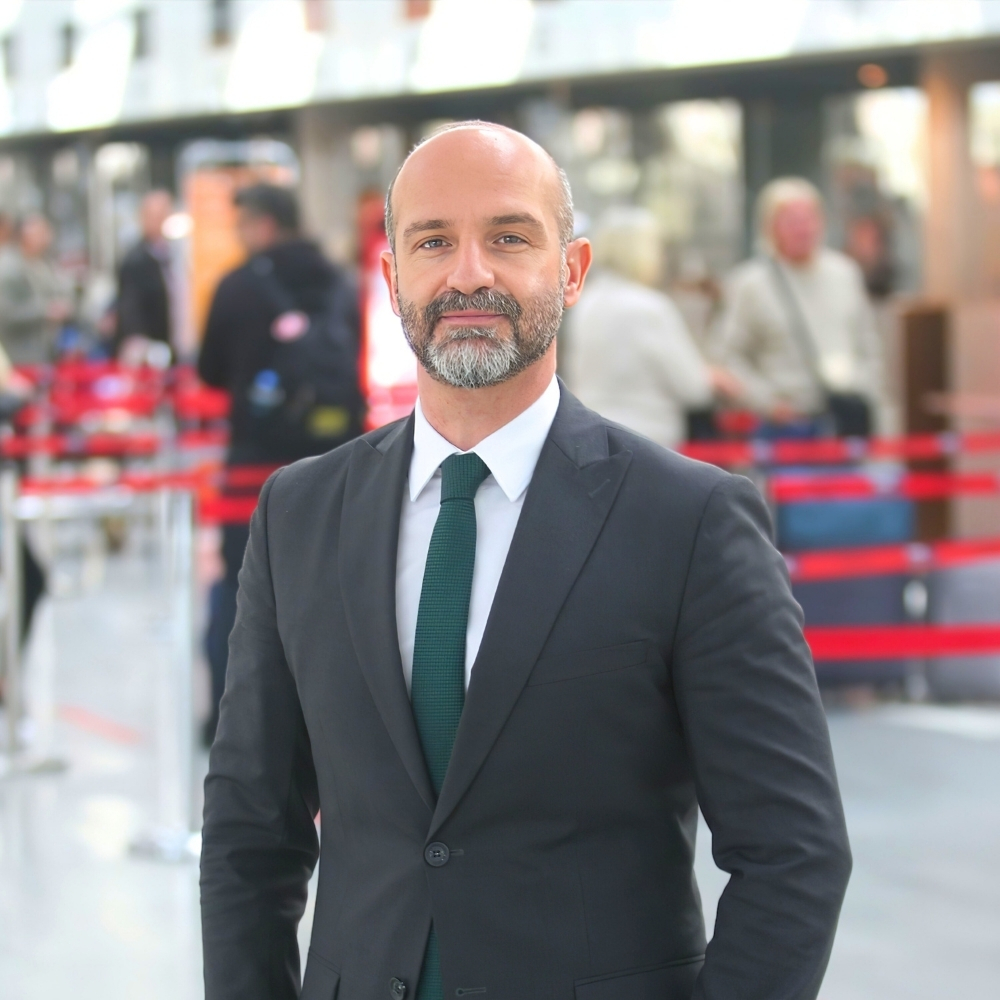
Interview with Roel Hellemons
Eindhoven Airport is among the world’s first ten pioneers to reach Level 5 in the Airport Carbon Accreditation programme. Can you share the key highlights of your journey to fulfil all the requirements of the new topmost level of our programme?
To reach level 5, it was very useful that Eindhoven Airport had already set out the relevant goals in the Planet Roadmap. Eindhoven Airport is taking concrete steps to reduce the CO2 emissions and other greenhouse gases. When reaching level 5 last year we reduced our own CO2 emissions by no less than 97 percent (compared to 2010). In addition, we are working together with partners and users of the airport to achieve the zero emission goals, especially for reducing Scope 3 emissions.
During the process of reaching level 5, we collaborated with the other pilot airports and figured out various components. We received support from our management team during this process and discussed the important aspects with them.
The journey to Level 5 accreditation demands a comprehensive strategy for addressing both direct and indirect emissions. Could you outline your key initiatives aimed at reducing Scope 3 emissions? How has Eindhoven Airport collaborated with airlines, suppliers, and other partners to encourage collective action towards emissions reduction?
Eindhoven Airport implemented, besides the goals in the Planet Roadmap, additional measures to become a quieter airport with lower CO2 emissions by 2030. These measures are related to reducing the CO2 emissions from air traffic: for example, focusing on the newest generation of aircraft and a higher blending requirement for SAF.
With a waste contractor, Eindhoven Airport set up a Zero Waste Roadmap with set goals until 2030. Eindhoven Airport aims to have zero waste by 2030, all waste thereafter will be reused or recycled.
Together with our ground handlers, Eindhoven Airport has a Zero Emission Roadmap for ground service equipment. We are reducing emissions on the apron by replacing diesel-powered vehicles and equipment with electric and/or more sustainable variants. As an interim step, we recently switched from fossil diesel as fuel for our diesel-powered ramp equipment and vehicles to HVO100. HVO100 is a renewable fuel that significantly reduces greenhouse gas emissions from combustion processes. Compared to fossil diesel, HVO100 reduces CO2 emissions by up to 90%, fine particles by up to 33%, and nitrogen oxides by up to 9%.
Finally, Eindhoven Airport has developed a Mobility Roadmap for all types of transport for passengers and employees. This Roadmap includes the initiatives of partners as the City of Eindhoven and taxi companies.
How does Eindhoven Airport engage with the local community in its decarbonisation initiatives?
Eindhoven Airport regularly communicates with the local community through meetings of the Eindhoven Airport Consultation (in Dutch: Luchthaven Eindhoven Overleg). Other consultation participants besides Eindhoven Airport and local residents include the air base, surrounding municipalities, the province, ministries and various other agencies. In different steering committees and working groups various topics are discussed, such as noise pollution, air quality, and contribution to climate goals.
We communicate extensively with the community about what we are doing in terms of sustainability and reducing noise nuisance, and the steps we are taking in these areas. We provide information through our social media channels, online in various daily newspapers and in (news items) on our site. The BurenApp Eindhoven Airport provides information and is equipped with a tool with which air traffic can be monitored live.
With the expansion of Eindhoven Airport’s terminal on the horizon, could you highlight the sustainability features, technologies, and innovations set to define this new development? Which sustainable practices are being integrated into the design of the expansion, and how will these help you reach your decarbonisation targets?
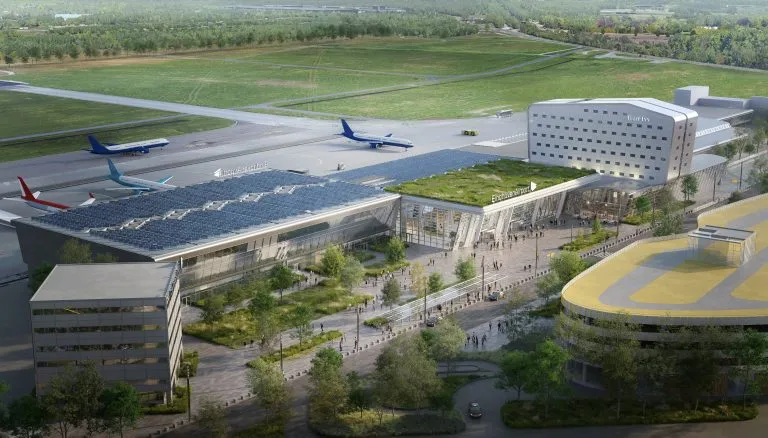
In the design of the expansion, sustainability was an important aspect. For example, materials will be reused, such as the facade parts from the existing terminal. The expansion of the terminal will be gas-free, as for heating and cooling a thermal storage system will be used. Almost 1,100 solar panels will be installed on the roof of the terminal expansion. Part of the roof will be planted with sedum. In the basement there will be a water basin where rainwater will be collected: that water will be used for our toilets.
How does Eindhoven Airport’s “Sustainable aircraft taxiing and APU usage on stand” project, which aims to reduce aircraft emissions, contribute to the airport’s decarbonisation efforts and overall sustainability goals?
 The purpose of this project is to gain more insight into potential noise and air emission reductions from aircraft taxiing (with reduced active engines) and APU usage. During this project a monitoring system with sound cameras will be set up to detect whether an engine and/or APU is in-/active. This monitoring system can also be used to manage future regulations regarding engine- and/or APU usage.
Level 5 is a blueprint for Net Zero carbon balance at airports and as we’ve seen with Eindhoven Airport’s achievement, it is feasible already today. Are you confident that the industry will decarbonise by 2050, considering the much larger and harder to abate chunk of emissions that come from flights?
The aviation industry faces significant challenges to fully decarbonise by 2050. As an airport, we are doing everything we can to contribute to this goal, but we are not responsible for all parts of the decarbonisation footprint. Continuing to invest in good partnerships is certainly important.
Looking ahead, what are your future plans within Airport Carbon Accreditation and what advice would you give to airports considering embarking on the journey to Level 5?
We want to stay informed of developments within the Airport Carbon Accreditation programme and furthermore we want to remain a pioneer! My advice for other airports: just try! Determine if you can meet the requirements of level 5, perhaps more requirements can be met than you initially expected. Furthermore, the input of several departments and stakeholders is needed to collect the required data to complete the footprint, so it is important to involve them from the beginning.
If you liked reading this, you might also enjoy: