Media
Interview with Koen Pouw
Rotterdam The Hague Airport was among the world’s first ten pioneers to reach Level 5 in the Airport Carbon Accreditation programme in December 2023. Can you share the key highlights of your journey to fulfil all the requirements of the topmost level of our programme?
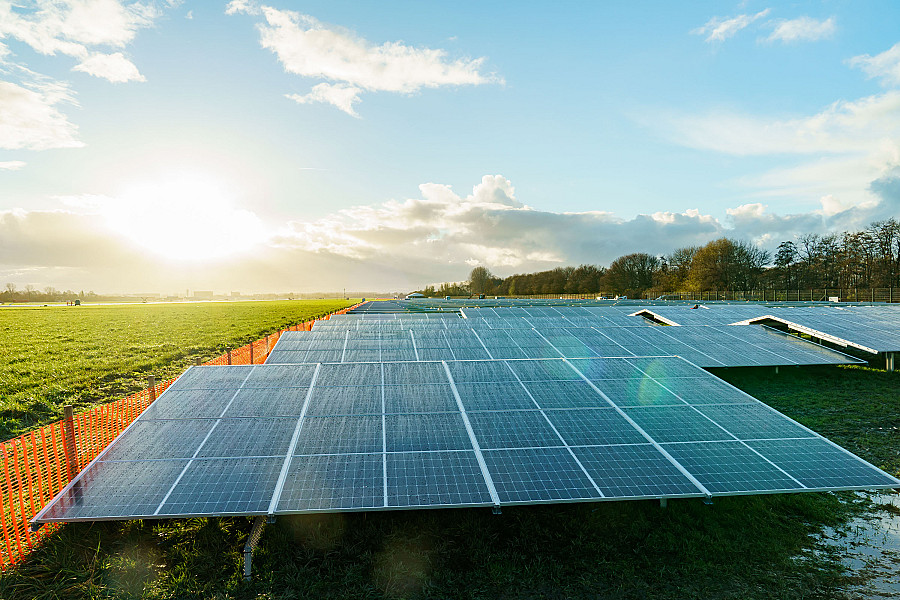
One of the most important requirements for Level 5 accreditation is the achievement of 90% CO2 reduction for scope 1 and 2 emissions compared to the baseline of 2010. The main sources of emissions for scope 1 and 2 are energy consumption by airport owned buildings and assets as well as fuel consumption by ground vehicles and equipment owned by the airport. In order to reduce these emissions by at least 90%, we have put many efforts towards becoming more energy efficient, reducing our gas consumption by switching to thermal energy (aquifer) for the heating and cooling of our terminal building, and simply lowering the thermostat in our buildings. We have a 100% renewable energy contract and also generate our own renewable energy. We have installed solar panels on our terminal building, our baggage handling facility, our fire station and two hangars. We have also installed a large solar park along the runway consisting of more than 37,000 solar panels (generation about 14 GWh annually). This energy will be much needed as we continue to electrify our assets and operations.
To reduce emissions from fuel consumption by airport owned vehicles and equipment, we have started replacing internal combustion engine vehicles with electric vehicles. In the meantime, we have banned fossil diesel for ground vehicles and equipment at the airport (airside) and only allow HVO100 fuel[1] – which reduces fossil CO2 emissions by up to 89%. HVO100 will be used by non-electric light vehicles until they are replaced by electric alternatives as well as heavy duty equipment that is difficult to replace by zero emission alternatives (e.g. fire crash tenders and kerosene trucks).
The journey to Level 5 accreditation demands a comprehensive strategy for addressing both direct and indirect airport emissions. Could you outline your main initiatives targeting Scope 3 emissions? In what ways has Rotterdam The Hague Airport worked with airlines, suppliers, and other partners to foster collective action towards third party emissions reduction?
Another important requirement for Level 5 is to commit to net zero emissions for scope 3 emissions and to have a strategy in place to achieve this target. With aviation emissions taking up the largest portion of the total scope 3 emissions of the airport, aviation emissions pose a significant challenge to reduce. Rotterdam The Hague Airport supports the development of new aircraft technologies such as electric and hydrogen-powered aircraft together with industry partners. In 2023, Rotterdam The Hague Airport reached a long-term agreement with Shell to introduce Sustainable Aviation Fuel (SAF) at RTHA, starting with 2% SAF blending in 2024.
Furthermore, we have included our target Zero Emission airside operations in 2030 in our Airport Rules – meaning all operational partners on the airside will be prohibited from using (light) internal combustion engine vehicles and equipment after 2030. Many vehicles and equipment have been replaced by electric alternatives, the remaining non-electric vehicles use HVO100 until they are replaced by electric alternatives.
Other emissions include upstream and downstream emissions relating to waste handling. RTHA is now collaborating with Renewi[2] and Seenons [3] to transition from waste handling to material flow management in order to become Zero Waste in 2030. This means there is as little incinerated waste as possible and a more sustainable handling of disposed materials to ensure no resources are lost. This also requires close collaboration with airport partners (retail, F&B, airlines, etc.) to initially prevent waste through more sustainable procurement of products and materials.
How is Rotterdam The Hague Airport incorporating technology and innovation in its infrastructure developments to support its decarbonisation goals?
To reach our decarbonisation goals, more and more assets are being electrified. This is the case for ground vehicles and equipment, but also for buildings. We therefore use renewable energy solutions such as solar panels, thermal energy (aquifer) and heat pumps to generate energy. With the fleet of electric vehicles growing – both airport and partner owned – the demand for electricity grows which causes the need for sufficient grid capacity and charging infrastructure. We have also installed an EASA-approved charging facility for the first Dutch registered electric aircraft, the Pipistrel Velis Electro.
You have set an ambitious target of at least an 8% usage of Sustainable Aviation Fuels (SAF) to align with the Dutch aviation sector’s goals. Could you explain your strategy for achieving this target and the importance of reaching it, for Rotterdam The Hague Airport?
The ReFuelEU legislation mandates the blending of SAF at a European level, starting with 2% in 2025 and increasing to 6% in 2030. In the Netherlands, the aviation industry has set the target of 14% SAF blending in 2030. Therefore, to fill this gap, we have reached a long-term agreement with Shell to introduce SAF at RTHA, starting with a 2% voluntary SAF blending in 2024 on top of the ReFuelEU mandate. This increases by 1% every year until 8% in 2030. Combined with the 6% target of ReFuelEU, this allows us to achieve the 14% target in the Netherlands.
Rotterdam The Hague Airport has launched the “Fly on SAF” tool in collaboration with SkyNRG and CHOOOSE, offering passengers the opportunity to purchase SAF. Can you tell us more about how this initiative works and its impact on reducing CO2 emissions? How has the response been from passengers and airline partners?
We offer passengers the possibility to purchase SAF using the Fly on SAF tool. Passengers can calculate the CO2 emissions of their flight and purchase SAF accordingly. The SAF is then used via the Book-and-Claim system – meaning that SAF is not actually supplied to the aircraft of the person who made the contribution, but delivered to the fuel system of an airport close to the SAF production facility. This also minimizes CO2 emissions and costs in the supply chain (source: Fly on SAF ⎮ By SkyNRG and CHOOOSE™).
Looking ahead, what are your future plans within Airport Carbon Accreditation and what advice would you give to airports considering embarking on the journey to Level 5 of Airport Carbon Accreditation?
Having reached net zero CO2 emissions for scope 1 and 2, our biggest challenge lies in reducing scope 3 emissions. Reducing ground emissions from partner vehicles and equipment, for example, is progressing well – so we are confident we’ll meet our 2030 target. Reducing upstream emissions – e.g. procurement of goods and services and capital goods – stimulates us to transition to a more circular economy and take into account indirect emissions. We will remain focused on reducing these emissions through more sustainable procurement. As mentioned before, however, our most significant challenge lies in reducing aviation emissions. We continue to focus on reducing the demand for fossil kerosene by stimulating fleet renewal (e.g. through discounted airport fees) and upscaling SAF uptake. Looking into the future, we’ll closely follow the development of electric aircraft in order to be ready to safely facilitate these new aircraft at our airport when they come to market. Contributing to the development of hydrogen-powered aircraft is one of our main focus areas to decarbonise commercial aviation. In the coming years, we will perform various pilots with industry partners (through EU-subsidised projects) to further the development of different stages within the chain of operations of hydrogen-powered aircraft at airports. This includes hydrogen refuelling on the apron, propulsion system testing on airside, performing an emergency response to an emergency aircraft (considered as a hydrogen-powered aircraft), as well as performing a test flight on hydrogen with Zero Avia[4].
Our advice to other airports who are starting out to become accredited at Level 5 is to focus on reducing the scope 1 and 2 emissions they can impact the most and which results in the highest emission reduction. As for scope 3 emissions, it is of key importance to collaborate closely with all stakeholders involved and make agreements to align them with your targets. With Level 5, airports become increasingly committed to reducing aviation emissions, so working with airlines is very crucial. This also requires focusing your efforts on the development of new aircraft technologies but also supporting policy development for emission reduction in aviation. There is no single solution so we must diversify our efforts and work with partners in the industry.
[1] HVO100 is a high-quality renewable diesel fuel made from hydrogenated vegetable oils and animal fats. It is a fossil-free fuel that reduces CO2 emissions by up to 90% compared to conventional diesel. HVO100 can be used in diesel engines without modification and is considered a sustainable alternative to fossil fuels, contributing to reduced carbon emissions and improved air quality.
[2] Renewi is a leading European waste management company focused on recycling and sustainability. Specialising in turning waste into valuable resources, Renewi works across various sectors to reduce environmental impact and promote a circular economy. By recycling materials that would otherwise go to landfill, the company helps businesses and communities achieve their sustainability goals.
[3] Seenons is a tech company dedicated to creating a waste-free world. As Europe’s only independent platform for waste recovery, Seenons connects waste producers with organisations that can reuse it, helping to reduce waste and accelerate the shift towards a circular economy. Through innovative solutions, the company aims to transform waste management and promote sustainability.
[4] ZeroAvia is a company developing hydrogen-electric propulsion systems for aircraft. Their mission is to revolutionise aviation by delivering zero-emission flight solutions, significantly reducing the sector’s environmental impact.
If you liked reading this, you might also enjoy: